
Law on Point
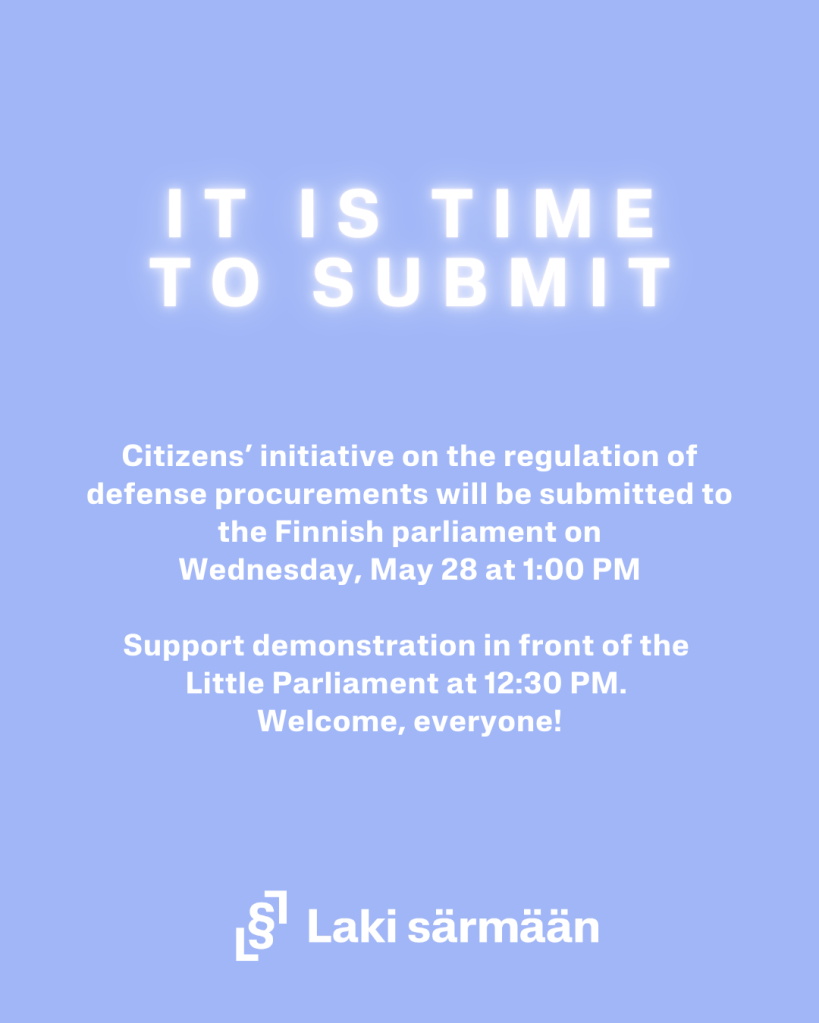
The citizen’s initiative to regulate defense procurements suggests that, when making defense purchases, Finland should take international human rights treaties and the realization of the objectives of international humanitarian law into account. Exports are already regulated in this way, but procurements are carried out through a tendering process where performance, price, and security of supply are the primary considerations.
The initiative proposes extending the current export practices to imports and defense procurements. This would make it possible to bring the discussion about war crimes and other violations of international humanitarian law into Finland’s defense procurements, instead of being able to justify procurements from anywhere on the grounds of security policy.
Read the English translation of the initiative text below and sign here!
Initiative to regulate defense procurements
We, the signatories, propose that the parliament requires the government to undertake legal preparations to regulate defense procurements and to present a governmental proposal regarding this to the parliament as soon as possible. The initiative proposes that defense procurements take into account international human rights agreements and the objectives of international humanitarian law as well as other foreign and security policy concerns. In addition, the law must specify that oversight adheres to best practices.
Current state
Arms procurements by the Finnish state are regulated by the Act on Public Procurement in the Fields of Defense and Security (1531/2011) [1]. According to the law, defense procurements are conducted through a bidding process, which prioritizes performance capacity, price, and security of supply. Meanwhile, there is no explicit obligation to consider the human rights or security situation in the exporting state.
This practice differs from the export of defense equipment which is regulated by both Finnish national laws and international agreements. Finland is party to the United Nations’ Arms Trade Treaty (SopS 33/2014) [2], which is intended to block arms export to countries in which exported weapons might be used against civilians or to perpetrate genocide, human rights violations, or war crimes. Finnish arms exports are also regulated by the Common Position of the Council of the European Union (2008/944/YUTP) [3] as well as the Act on the Export of Defense Materiel (282/2012) [4].
According to the Act on the Export of Defense Materiel (282/2012), significant arms export licenses are granted by the Government’s plenary sessions, and in other cases, by the Ministry of Defense. However, when necessary, the Ministry of Defense must obtain an assessment from the Ministry of Foreign Affairs on the impact of foreign and security policy factors. The Ministry of Foreign Affairs is, furthermore, represented in the defense materiel export working group, set up by the Ministry of Defense. The website of the Ministry of Foreign Affairs notes that the assessments must consider the situation in the destination country, particularly in terms of human rights [5].
Rationale
The central question in defense and security equipment acquisitions is security of supply. In a military context, security of supply refers to performance ability and cost efficiency as well as the capacity for maintenance and to acquire equipment, even under exceptional circumstances [6]. Finnish defense is planned on a time frame of multiple decades.
The realization of human rights [7] and international humanitarian law [8] in countries from which defense equipment acquisitions are made significantly impacts Finland’s security of supply. Finland has made sizable procurements from Israel, a country that is currently being accused of genocide [9] in the UN International Court of Justice (ICJ) and has been condemned for its illegal occupation of Palestinian territories [10]. The availability and security of supply of acquired military systems are jeopardized if the country from which Finland makes defense procurements violates international law and becomes the target of sanctions.
Sanctions, such as bans on the export and import of arms, are a significant form of influencing the actions of other nations [11]. Alongside other sanctions, the European Union has set defense equipment import embargoes on nations that act in violation of international humanitarian law [12]. For example, the EU has set an arms embargo on Russia since its invasion of Ukraine [12], and in 2002, the European Parliament voted for an arms embargo on Israel and Palestine [13]. The failure to assess the human rights and international humanitarian law situation in the process of security and defense procurements leaves Finland in an insecure position
Arms procurements create dependence on the country of origin. Once high technology military products have been acquired from a specific manufacturer, it is beneficial, and at times nearly unavoidable, to continue cooperation with the same manufacturer in the future. Finland’s dependence on the same manufacturer for future product updates and maintenance limits Finland’s ability to set sanctions on the country of origin. Additionally, a country that is actively engaged in warfare may struggle to deliver purchased products, or the country may end up using the products themselves [14].
Arms exports are regulated to ensure that the exporting state does not become complicit in prolonging conflicts and human rights violations in the target country. For the same reason, the arms imports from a country that is guilty of committing war crimes and violating international humanitarian law is problematic. Many arms manufacturers are either owned by or otherwise deeply embedded with their state, with governments being defense companies’ most important buyers [15]. If the country from which defense acquisitions are made is actively engaged in warfare or involved in prolonged conflicts, arms procurements can, in the worst case, provide an economic incentive for the conflict to continue. Many weapons manufacturers also cooperate with the armed forces in their country to test weapons systems in real conflicts [16]. For example, Israel’s ability to test their weapons systems in the Occupied Palestinian Territories provides the Israeli arms industry a competitive advantage, with the current war in Gaza increasing demand for Israel’s defense industry [17,18].
Furthermore, the law should require the application of best practices when conducting human rights and international humanitarian law impact assessments for the import of defense and security equipment. Best practices guide which agency is responsible for the assessment and the kinds of sources such assessments shall be based on. Such sources would be, for example, the UN International Court of Justice and the International Criminal Court, as well as the resolutions of the United Nations General Assembly, the UN Security Council and the UN Human Rights Council, in addition to the statements of independent experts of the United Nations. Implementing best practices would safeguard against leaving significant decisions in the hands of a single minister, particularly in a rapidly shifting and unpredictable global context.
The states with which Finland engages in the arms trade with affects Finland’s international reputation and status as a member of the international community. Finland has profiled itself as a consistent defender and developer of international justice as well as a promoter of democracy and human rights. As a small country dependent on cooperation, maintaining the international rule of law is in Finland’s national interest [19].
Finland was one of seven initiating countries behind the United Nations Arms Trade Treaty (SopS 33/2014) and one of its first signatories. A report on the Arms Trade Treaty funded by the Ministry of Foreign Affairs [20] states that despite regulation, even Nordic countries’ arms export regulations have flaws which enable exporting arms to conflict regions. According to the report, it is therefore crucial to monitor international and regional development, undertake continuous risk assessments and regularly update arms control legislation and regulations.
Since the arms trade is linked to questions of human rights in terms of both exports and imports, it is justified to extend risk assessments concerning human rights and international humanitarian law violations to also include defense procurement decision-making.
Sources
[1] Laki julkisista puolustus- ja turvallisuushankinnoista https://www.finlex.fi/fi/laki/ajantasa/2011/20111531
[2] Yhdistyneiden kansakuntien asekauppasopimus (ATT, SopS 33/2014) https://www.finlex.fi/fi/sopimukset/sopsteksti/2014/20140033
[3] Euroopan unionin neuvoston yhteinen kanta (2008/944/YUTP) https://eur-lex.europa.eu/legal-content/FI/TXT/?uri=CELEX%3A32008E0944
[4] Laki puolustustarvikkeiden viennistä (282/2012) https://www.finlex.fi/fi/laki/ajantasa/2012/20120282
[5] Kuinka puolustustarvikkeiden vientiluvista päätetään https://um.fi/uutiset/-/asset_publisher/GRSnUwaHDPv5/content/kuinka-puolustustarvikkeiden-vientiluvista-paatetaan-
[6] Huoltovarmuuden määritelmä https://www.defmin.fi/vastuualueet/puolustusmateriaali_ja_puolustusteollisuus#c2f3fe37
[7] Ihmisoikeuksien määritelmä https://ihmisoikeudet.net/yleisesti/maaritelmia/
[8] Punainen Risti: Humanitaarinen oikeus https://www.punainenristi.fi/tyomme/humanitaarinen-oikeus/
[9] ICJ: Application of the Convention on the Prevention and Punishment of the Crime of Genocide in the Gaza Strip (South Africa v. Israel) https://www.icj-cij.org/case/192
[10] Yle: YK:n kansainvälinen tuomioistuin linjasi: Israelin jatkuva läsnäolo palestiinalaisalueilla rikkoo kansainvälisiä lakeja https://yle.fi/a/74-20100553
[11] Ulkoministeriö: Mitä ovat kansainväliset pakotteet https://um.fi/mita-ovat-pakotteet#Voimassa%20olevat%20pakotteet
[12] EU Sanctions Map https://www.sanctionsmap.eu/#/main
[13] European parliament resolution P5_TA(2002)0173, 10.4.2002 http://www.europarl.europa.eu/sides/getDoc.do?type=TA&language=EN&reference=P5-TA-2002-0173
[14] Iltalehti: Suomen mahtiase pitää sisällään erikoisia riskejä – Näin vastaa Antti Kaikkonen, joka hankki sen https://www.iltalehti.fi/politiikka/a/e8d45b1b-537d-4817-b600-ad0cefc1fbe9
[15] HS: Lisää aseita Euroopalle https://www.hs.fi/kirjeenvaihtajat/art-2000010489269.html
[16] U.S. Department of State: U.S. Arms Sales and Defense Trade https://www.state.gov/u-s-arms-sales-and-defense-trade/
[17] +972 Magazine: Gaza war offers the ultimate marketing tool for Israeli arms companies https://www.972mag.com/gaza-war-arms-companies/
[18] Yle: Suomi ostaa hirveästi aseita maalta, joka säikkyy Venäjää itsekkäistä syistä – ja siinä voi piillä riski https://yle.fi/a/74-20096895
[19] Ulko- ja turvallisuuspoliittinen selonteko https://julkaisut.valtioneuvosto.fi/handle/10024/165721
[20] Nordic Arms Transfer Controls and the Arms Trade Treaty: Strengths and Challenges
https://um.fi/documents/35732/48132/nordic_arms_transfer_controls_and_the_arms_trade_treaty/775fe516-1622-3cd3-2a3e-c9f2366b5d05?t=1525645980818
Yhteystiedot
Jenna Jauhiainen, tiedottaja
+358 40 836 1188
lakisarmaan@proton.me
 Laki särmään